It is always good to visit Bexhill’s splendid museum but this weekend there are two particularly good reasons, both in connection with the fire-brigade.
Firstly this week Bexhill Museum is proud to have on display, for the very first time, a newly restored Merryweather Fire Engine dating from 1895. Secondly this weekend marks the centenary of the death of a brave fireman, Sidney Wise who is buried under a magnificent statue of a fire-fighter at Bexhill Cemetery.
Bexhill was famous for its racing-cars and several are on display at the museum however one of the speediest vehicles in Bexhill in its day was the “MERRYWEATHER FIRST GRAND PRIZE PATENT STEAM FIRE ENGINE” and the beautifully restored vehicle now takes pride of place in the Motoring Gallery although of course, the vehicle was never a ‘motor’ but pulled by two horses.

Merryweather & Sons (Moses 1791-1872 and his son Richard (1839-1877) established their engine-making company in Clapham, South London. They made steam engines for tram-cars and agricultural machinery, but in the late 1800s their engineer Edward Field designed a fire-engine. This was a vertical steam boiler attached to a vehicle and used to pump water. The great advantage of this new patent boiler was that it was able to generate enough steam pressure to power fire-hoses in just 10 minutes. This meant that on the call-out to attend a fire, the fireman who lived closest to the fire station would stoke up the boiler. The firemen would attend the fire station, don their uniforms and the horses would be hitched up to the fire engine. Usually by the time the engine arrived at the scene of the fire there was sufficient pressure for the fire hoses to work immediately.
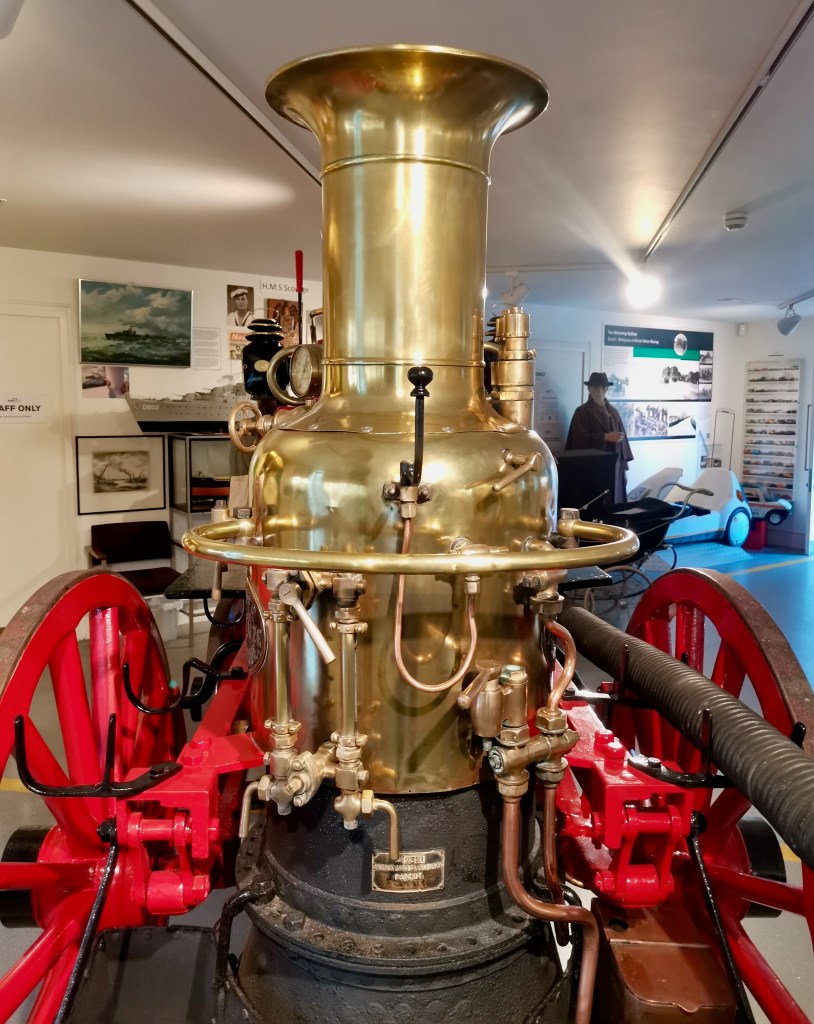
These new engines were particularly popular with Borough Fire Brigades who had previously had to pump water by hand. Bexhill Urban District Council purchased theirs in 1895. Marryweather not only made the engines, they also made the smart brass helmets too. One of these is on display at the museum.
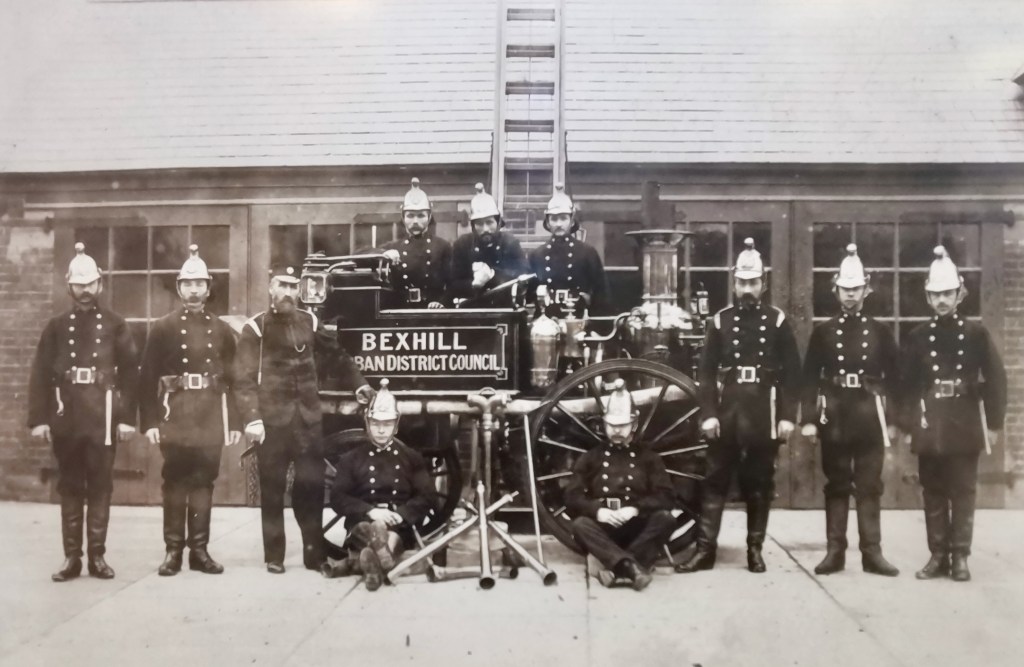
Here you can see the brigade posing in front of their smart new engine. It was in use until 1921 when a Dennis motor fire-engine was purchased. The old machine was promised to Bexhill Museum but it ended up hundreds of miles away in Northamptonshire.
Over the past few years the fire-fighters of the East Sussex Fire and Rescue Service have been raising funds to return the old Merryweather to it’s home in Bexhill. Sponsored walks, car-washes and open days have raised enough funds for the beautiful vehicle to be restored and displayed. It looks great ! Well done to the fire-fighters and the museum volunteers for all their hard work.
Whilst I was at the Museum I learned about Fireman Sydney Wise who died after fighting a fire exactly 100 years ago in September 1924. I then visited his amazing grave at the local cemetery.
Sydney Albert Wise was born in Lowestoft in 1899. When his mother died he was sent to Bexhill to be adopted by his uncle who was the Chief Officer of the local Volunteer Fire Brigade. He joined the fire brigade as a messenger in January 1912. One of his jobs would be to run around the town ensuring that the volunteer firemen had heard the maroon, (a large firework) which would alert them to run to the fire-station. At this time firemen had a sign outside their houses to show where they lived – one of these is on display at Bexhill Museum. Young Sydney was obviously keen and the following year at the age of fifteen he became a fully-fledged fireman and by the age of twenty-five was ‘Number One’ for Bexhill’s ‘hose-cart’ team. Sydney was always a keen member of the fire-brigade and always the first to respond to a call. He was a plasterer by trade and during the Great War had served with the King’s Royal Rifle Corps.
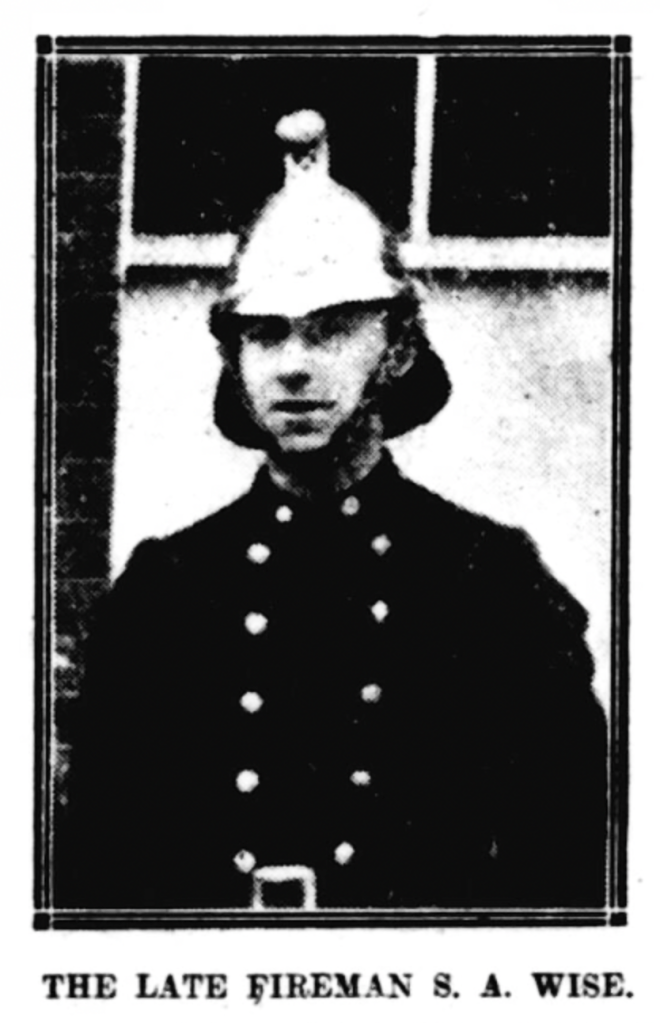
On the 19th September 1924 Fireman Wise was at home eating his supper when he heard the loud bang of the maroon which indicated that the fire brigade was needed. It was 10.25pm and the fire was at Miller & Franklin’s in St Leonard’s Road. The shop was a draper and ladies-outfitters with shops in Bexhill and nearby Eastbourne. Sydney must have been one of the first to the scene as just ten minutes after the call-out he had fallen from an escape ladder. He was carried unconscious to his home nearby in Windsor Road (which must have been traumatic for his young wife) and later to hospital where he died of his injuries a few days later on 23rd September 1924.
A subsequent inquest heard that at the time of his fall, the young fireman was stepping from the ladder onto a window-sill of the burning property. There was a suggestion that the escape ladder had failed but it was later tested and found to be in good order. A verdict of accidental death was returned.
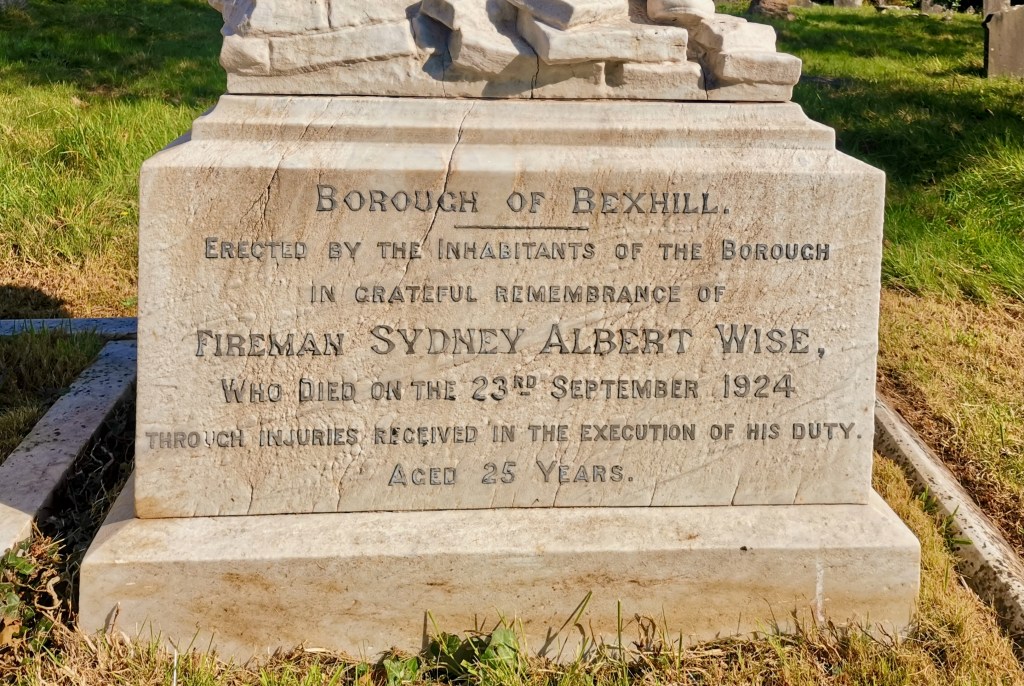
Sydney’s funeral was held on Saturday 27th September 1924. The coffin (his helmet and axe placed on top) was carried to Bexhill Cemetery on a fire-engine. The tragic death of this active young man clearly moved the people of Bexhill and on every anniversary of his death the Bexhill fire-brigade held a remembrance service at his graveside. In 1926 a unique memorial was placed above the grave in the form of a life-sized fireman holding a hose. It was executed in white Sicilian marble and the newspapers said it was the ‘finest figure of its kind.’ It certainly is and is still clean and bright as if new. If you get a chance do visit the grave to pay your respects and also go along to see the new Fire Brigade exhibit at Bexhill Museum – you won’t be disappointed.


 Quirky Sussex History by Kevin Gordon