The Right Honourable Henry Cope, Earl Vernor was a well known character in pre-Regency Brighton. He would walk around Brighton followed by a green carriage, driven by a green-uniformed groom. He himself wore all green and his lodgings were painted green with a green sofa and green bed. It was even said that he would only eat green food. You will not be surprised to hear that he was known as the Green Man.
Henry told everyone that green was ‘nature’s favourite colour’. He lived in the Old Steine, where he would entertain curious guests by reciting his own poetry. Every day this diminutive gentleman would parade up and down the Steine in central Brighton, wearing his green clothes (which even had green buttons) and flourishing a large green silk handkerchief. The only thing that was not green was his face. He powdered his face, ears and whiskers with flour.
A 1802 engraving in the British Museum shows Henry as a short man with green tinted spectacles, terrifying widows who call him ‘the monster.
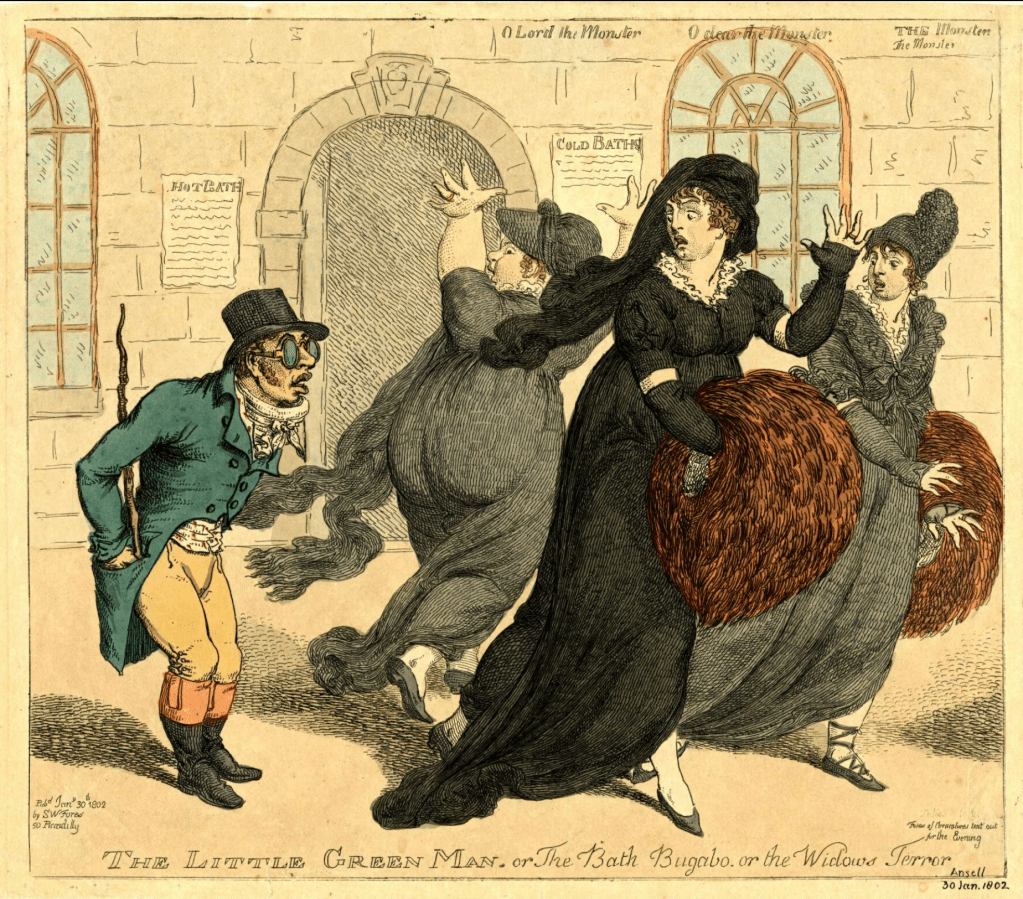
However a later picture, now in the National Portrait Gallery, shows him as an upstanding kindly faced man.

A poem circulated around Brighton…
A spruce little man in a doublet of green,
Perambulates daily the streets and the Steyne
Green striped in his waistcoat, his small clothes are green
And oft round his neck a green ‘kerchief I’ve seen.
Green watch string, green seals, and for certain I’ve heard
(Tho’ they‘re powdered) green whiskers, and eke! a green beard
Green garters, green nose and deny it who can
The brains too are green of this little green man.
Although he considered himself as something of a Dandy, his appearance would startle the ladies. He did have a girlfriend by the name of Dulcina but when she left him in October 1806 he tried to commit suicide by firstly leaping out of the window of his lodgings and secondly by jumping off a cliff. He failed and the following week the local paper reported ‘Mr Cope is pronounced out of danger from his bruises.’
By September 1807 the ailing eccentric was in St Lukes Hospital, London and, unable to pay his bills, he decided to sell off the contents of his Brighton home. The auction took place at the nearby Fisher Rooms in St James’s Street, and, as Cope was quite a celebrity, the sale attracted a good many bidders. A full green coat, pantaloons and waistcoat sold for a pound. Other green clothing sold quickly and of particular interest was his green ‘chapeau de bras’ – literally an arm-hat which could be folded down and carried under the arm. A watch and clock engraved with ‘Earl Vernor’s’ self-appointed coat-of-arms sold well.
St Lukes Hospital in Old Street, London was a hospital for ‘incurable pauper lunatics’ and it is probably the place of his death in 1810.
In 1938, author Winifred Ashton (writing as Clemence Dane) wrote a book titled ‘The Moon Is Feminine’ and made Henry Cope, the Green Man, her main character. In her book Henry believes he is descended from a race of sea-gypsies called ‘the Green People’ hence his fascination for the colour. A rich heiress, Lady Molly, falls in love with him but it all ends in tragedy when she follows a sea-gypsy into the Brighton waves and is drowned. The novel appears to show Henry as an eccentric but it is clear that the real-life Green Man was far more interesting!
Sources: Contemporary Newspapers accessed from the National Newspaper Archives. The Man Who Ate Bluebottles and other Great British Eccentrics by Catherine Caufield (2005)
For a more detailed report on Henry Cope see..
 Quirky Sussex History by Kevin Gordon