Family Roots (The Eastbourne Family History Society) have published the Monumental Inscriptions (MI) for many locations but I am particularly interested in those for St Mary’s Church, Eastbourne as I live close by.
Over the years many of the memorials have eroded and are now impossible to read. One of these is a cream-coloured marble ledger set into the south aisle close to the large Lushington memorial. For over two hundred years, the feet of parishioners have worn away most of the text.

The MI List shows:
Sacred to the memory of Elizabeth the wife of John ***** Bart of ***** in the County of Limerick 1819. ********* daughter who died ****** 16 1849.
Not much to go on, but I like a bit of detective work and wondered if I could find out more. I presumed they were mother and daughter but would I be able to ascertain their names?

A check of burials at St Mary’s for 1819 showed a possible candidate – Eliza Allen De Bourgh who was buried on 12th August aged 30 years.

Next, a search of the National Newspaper Archives revealed a small item in the ‘British Press’ newspaper for 16th August 1819:
DEATH: On the 5th instant, at her lodgings at Southbourne, Lady Eliza, the wife of Sir John Allan De Bourgh, Bart of Castle Cornell in the county of Limerick. Her remains were on Thursday morning interred at half past four o’clock in Eastbourne Church.
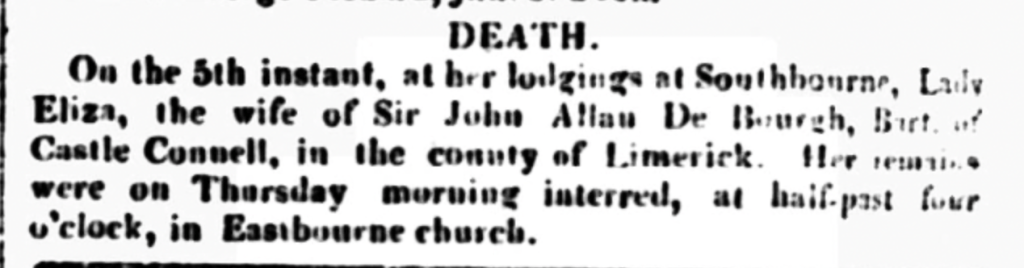
So now we know that the person buried at Sr Mary’s was indeed Eliza who was an Irish Lady.
The De Bourgh family lived in Castle Connel about 5 miles north-east of Limerick. The Baronage was created in 1785 for Sir John’s grandfather, Richard Burke, who then took on the posher surname ‘De Bourgh’. He married Elizabeth Hall in London in 1808. Elizabeth had been born in Kidlington, Oxfordshire in 1785. She was the daughter of Captain John Hall of the Royal Navy and sister of General Gage John Hall (The Governor of the Island of Mauritius). Elizabeth and Sir John were to have no children.
Elizabeth had lodgings at “Whyte’s Cottage”, Southbourne, the area around what is now Eastbourne Town Hall.
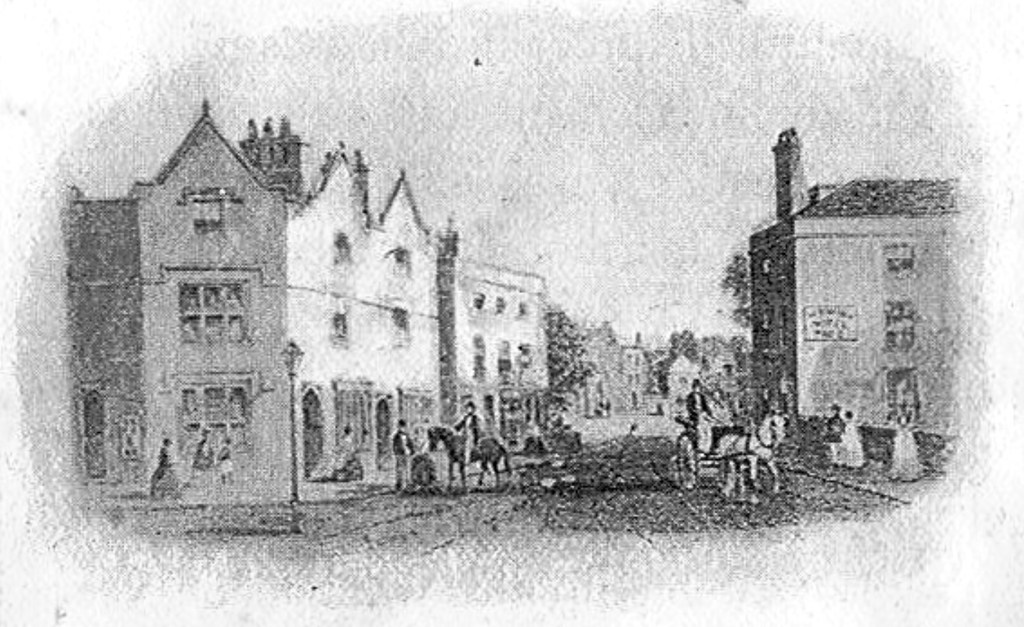
One brief obituary reported that she died of a ‘lingering illness’ so maybe she was in Eastbourne to convalesce. She must have had some rank or influence to be buried within the church rather than the graveyard and her grave-ledger would have been expensive and probably paid for by her husband Sir John who later remarried and died in Ireland in 1839.
So who does Lady Elizabeth share her grave with? We have no name or any other information other than a presumed date of death – 16th 1849. The grave slab is well worn…
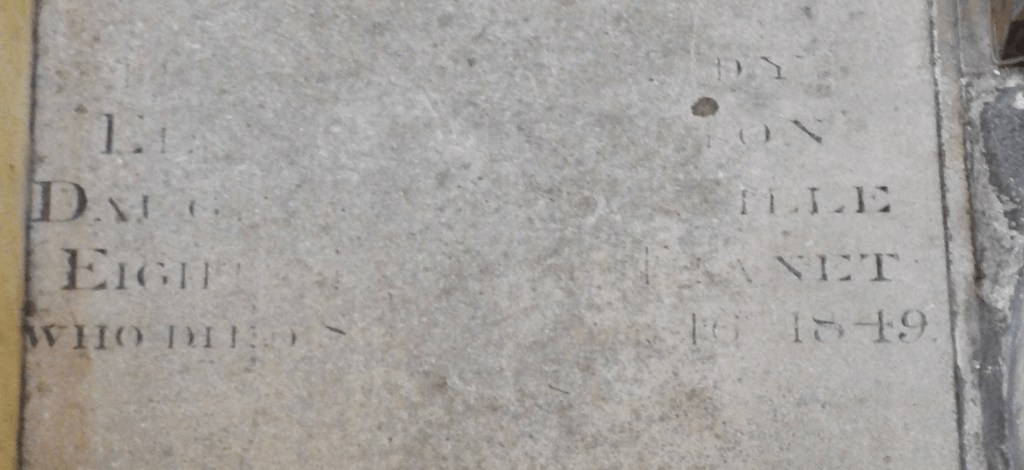
Some detective work reveals that, believe it or not, it is another Lady Elizabeth!
Again a check of the St Mary’s parish registers show just one likely candidate; on 25th September 1849, the Reverend Thomas Pitman buried Lady Elizabeth Tufton. The place of death is shown as Dover.
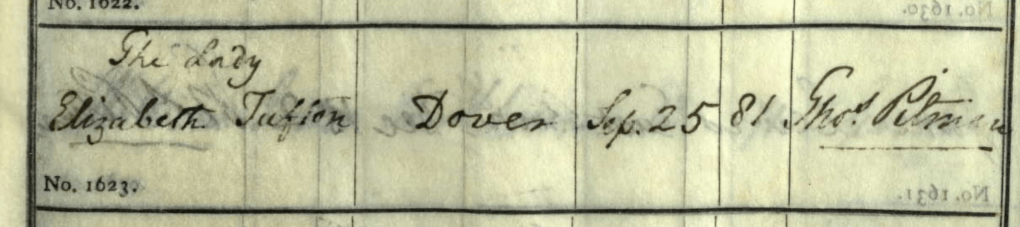
A search for her in the newspaper archives finds that her death is mentioned in the Illustrated London News of 22nd September 1849:

No mention of a burial at Eastbourne but the date and location of death match with the St Mary’s parish register. However, just like Lady Elizabeth De Bourgh we are left wondering what her connection to Eastbourne was.
The Tufton family were named after Tufton near Northiam in Sussex. John Tufton (1578-1631) was MP for Kent and was knighted by James I in 1603 and took the title Earl of Isle of Thanet in 1626. He owned Bodiam Castle.
Elizabeth’s father had five sons who would all inherit the title Earl of Thanet. She took the title from her brother Sackville Tufton (1769-1825) the 9th Earl, who was an interesting character having been a noted cricketer who had once spent a year incarcerated in the Tower of London having been found guilty of rioting. Another brother, Henry, the 11th Earl, was MP for Rochester and was also a noted cricketer. He had also been in prison having been arrested in France on the orders of Napoleon.
Elizabeth had a more sedate life. She lived at 11, Cumberland Street, in the prestigious Portman Square area of London. She was single and regularly travelled to spas and coastal resorts including Leamington Spa, Dover and Hastings. The Sussex Advertiser of 16th April 1838 reports ‘Eastbourne, cheered by fine weather begins to show its natural splendour. The farmers are thankful to Providence, for such a season for lambing seldom occurs. Wheat is wonderfully improved and the season for barley sowing is everything that can be wished for. The mild weather is of benefit to lodging-house proprietors as the season has started under flattering circumstances. Lady Elizabeth Tufton has taken apartments at the Lamb Hotel’.
Elizabeth died in Dover but why was her body brought to Eastbourne for burial in St Mary’s Church? It would have been done at a considerable cost. Why was she not buried in Dover or taken to her home in London? Maybe she considered Eastbourne her home? – maybe she was a permanent resident of the Lamb Inn? (note that she took apartments – in the plural rather than just one room.) Again, she must have had some standing in the community to be buried within the church rather than the churchyard. Did she have any connection with the other Lady Elizabeth whose tomb and grave-ledger she shares?
We may never know what connection these two Lady Elizabeths had with Eastbourne or each other but we do now know their names which had previously been lost to history under the feet of thousands of St Mary’s Church visitors.
 Quirky Sussex History by Kevin Gordon