Although I was born 12 years after the end of the Second World War, it was fresh in many people’s minds and there was still physical evidence to be seen in the form ‘bomb-sites’; I particularly remember the gaps, like missing teeth, in the smart terraces of The Avenue in Eastbourne and also old Home Guard gun-slits, like those on the corner of The Goffs and Southfields Road and on the seafront at Seaford.

I also remember the rusty, dark Anderson Shelter in the back of my Nan’s house in Gordon Road, Hailsham. It was difficult to think what it must have been like to cower in fear during an air-raid, although some children found it quite exciting. My father Roger, was nearly killed in the first air-raid on Eastbourne July 1940. He was later sent to a boarding school in Eastbourne and remembered another visit by the Luftwaffe – “On Sundays we would attend church and would then usually go for a walk, often down Ocklynge Road, through the Parish churchyard and Vicarage Road and Love Lane to the Golf Links. One Sunday, we were caught in an air raid and laid down in a golf-bunker watching a dog-fight over the town which was quite exciting, but very noisy as the guns were quite close to us. Many incendiary bombs dropped on the golf-course and left round burnt patches. Us school boys would sometimes collect the spent shells from the anti-aircraft guns.”

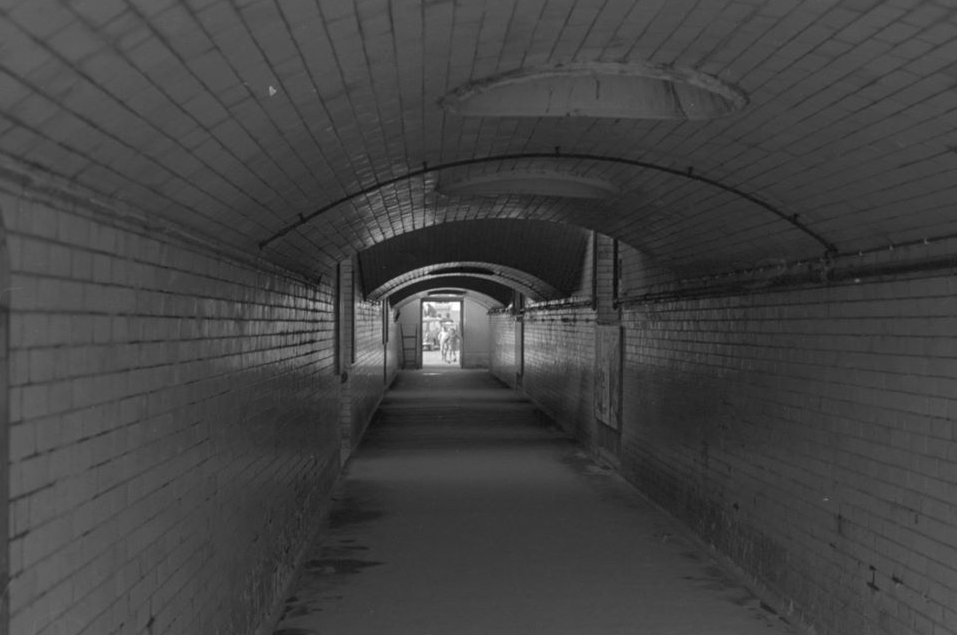
My mother Jean also remembered the enemy air-raids. She was at school in Hailsham and wrote “One day we were walking home when we heard a plane flying low overhead. It was so low that we could see the pilot in the cockpit and waved at him. We then saw the iron cross on the plane and realised that it was German. He started to let his bombs out and they came down in the fields behind Gordon Road. Another German plane crash-landed on the Hailsham to Boship Road. All the children ran along Western Road, and under the main road where the cattle went. We saw the crashed fighter which had nose-dived into a field. The airman was dead and there was a lot of blood. We cheered and cheered. Now, I think it was someone’s son or husband, but at the time we thought it was one less plane to come and bomb us.” Every time we walked under the tunnels at Polegate Station my Mum reminded me that that is where she had run to safety during one raid.
I was reminded of the war over Sussex when I recently visited the Imperial War Museum at Duxford in Cambridgeshire. I was interested to see a German Messerschmidt fighter-plane on display. It seemed to be pretty much intact apart from its bent propellors. The adjacent information sign recorded that it had crash-landed in Sussex during the Luftwaffe’s last major daylight raid on London in September 1940.
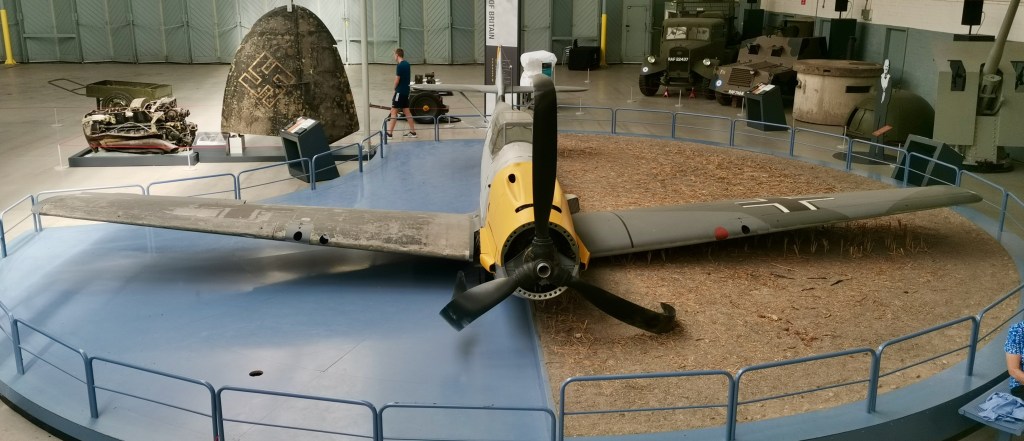
I learnt that this was a Messerschmidt Bf 109 E-3 aircraft which had been escorting and protecting larger bombers heading for London on 30th September 1940. It was being flown by a 22 year-old inexperienced pilot, Unteroffizier (Corporal) Horst Perez of Jagdgeschwader 26 Schlageter (JG26) which was a fighter-wing of the Luftwaffe. The unit was based near Calais and named after Nazi hero Albert Schlageter, who had been executed by the French in 1923. Each of the aircraft in the squadron were marked with a gothic-style letter S to commemorate him and this can still be seen on the aircraft at Duxford. This particular plane was called ‘White 4’ after the number on its side.
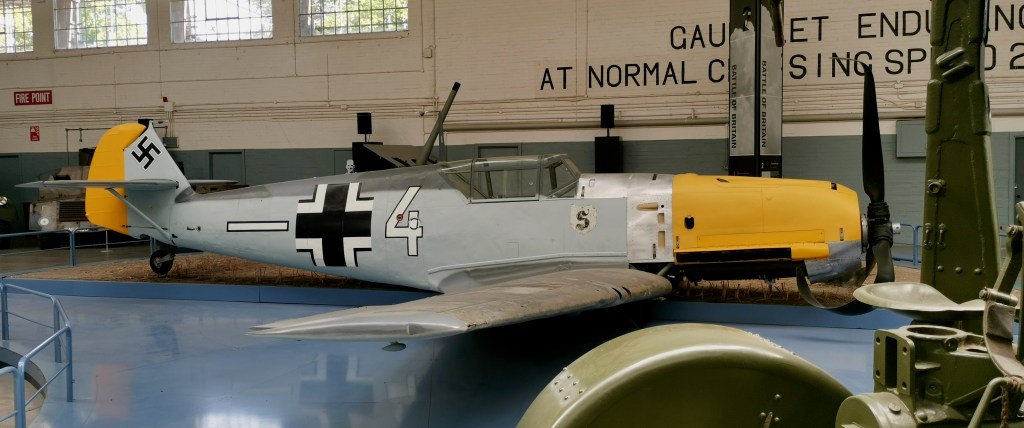
It was late afternoon on Monday 30th September 1940 when White 4 was involved in a dog-fight with 92 Squadron of the RAF who were protecting our vulnerable coastline at Eastbourne.

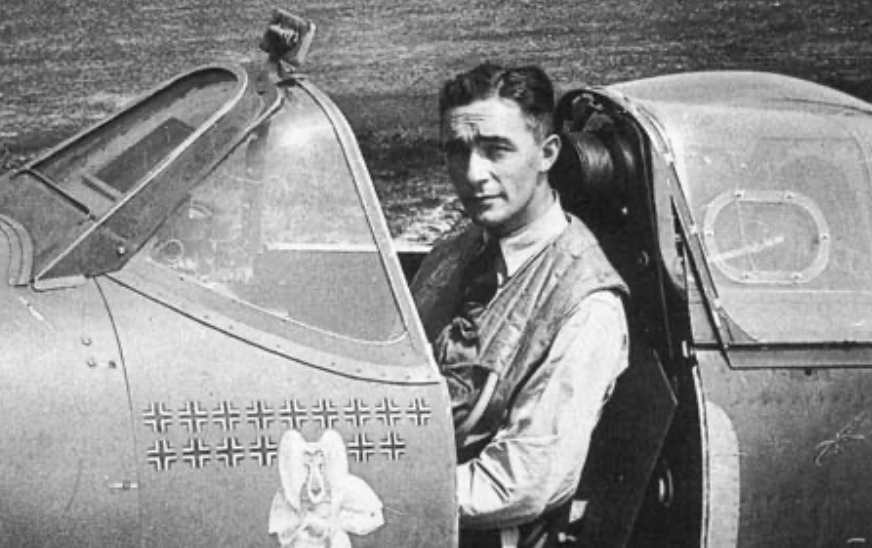
A Hurricane, flown by 21 year old Sergeant Donald Kingaby, engaged with White 4 over Beachy Head and soon afterwards, it crash landed in a field near East Dean without engaging its landing gear. Exactly what happened is not known. Sergeant Kingaby claimed the hit although there were no bullet holes in the fuselage of the downed plane. Kingaby went on to be a top RAF ace and the only person to be awarded the Distinguished Flying Medal three times. This one of the first Messerschmitt Bf109’s he claimed – it was to be the first of many.
The exact reason why Unteroffizier Perez’s aircraft landed is not known. He claimed that the engine had failed but there are suspicions that he simply gave up and surrendered. I have read a theory that, as his surname ‘Perez’ is Spanish and not German he may not have been ‘accepted’ as a ‘true Arian’ by his colleagues. Whatever the reasons, he survived the crash as did his aircraft.
Three days before White 4 landed at East Dean there had been an interesting incident along the coast at Seasalter near Whitstable, Kent. The four-man Luftwaffe crew of a downed Luftwaffe Junkers bomber had apparently opened fire on soldiers who had tried to detain them. There was a brief exchange of fire, the Germans were captured and taken to the local pub for a few beers (honest!). This was known as the Battle of Graveney Marsh and is known as the last war-time military engagement on British soil.
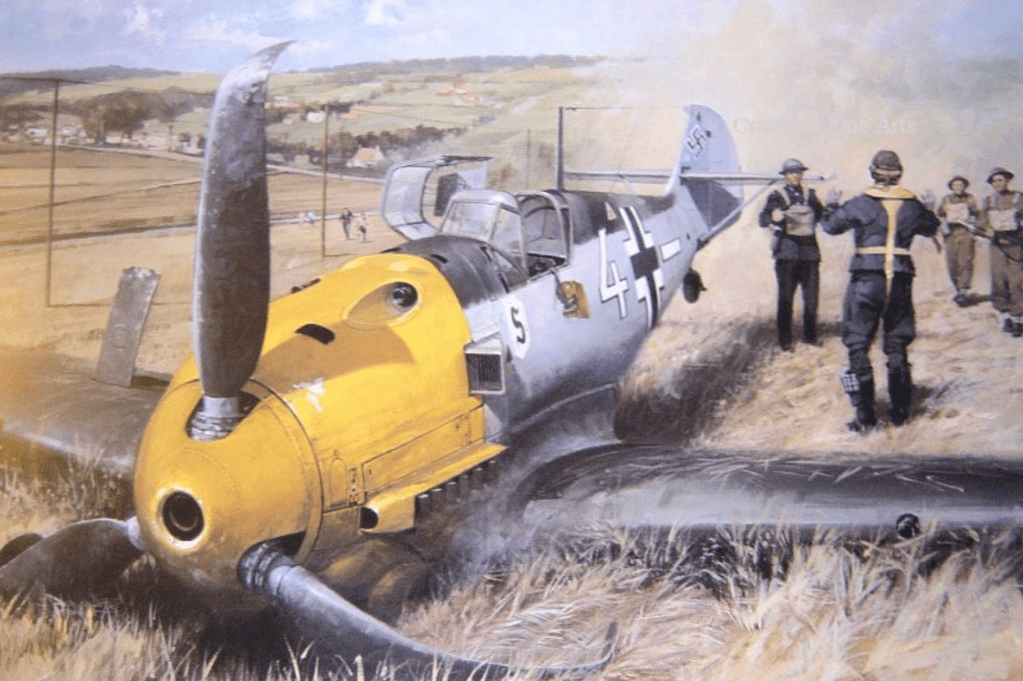
Military units protecting the Sussex coast would have been on full alert, and in East Dean, the sound of the dog-fighting would have been unmissable. When Horst climbed out of White 4 at about 5.30pm that Monday afternoon, soldiers from the Devonshire Regiment stationed nearby, were on the scene immediately and, probably aware of the recent gun-battle in neighbouring Kent, promptly shot him as he tried to surrender. Horst was injured in the leg and face and on detention was punched. Shortly afterwards local Police Constable Walter Hyde arrived and arrested him – maybe saving him from further harm.
Another account of the incident was published in the Royal Air Force Flying Review.

A Mr D.G.E. Collins of Brighton wrote:
“I saw the aircraft within a few hours of its belly-landing some yards from the Seaford -Eastbourne road, approximately a mile east of the village of East Dean. I was travelling to Eastbourne when I saw the aircraft under guard of a soldier from the Devonshire Regiment. After a preliminary conversation, he allowed me to examine the aircraft closely. He told me that the aircraft had appeared from the general direction of London and, as the pilot presumably had some ammunition left, he took the opportunity to use this by strafing the troops and a flak emplacement in the nearby village. He was shot down for his pains. He belly-landed on a slight incline, threw open the cockpit hood, jumped from the aircraft and started running in the direction of the road, drawing his revolver as he ran. By this time, some troops had arrived within rifle range and sent a volley in his direction. The pilot then stopped and raised his hands. One of the soldiers, presumably being somewhat put out by the strafing, hit the pilot in the face with his fist , for which he was promptly punished by being confined to barracks for seven days. My informant did not disclose the pilot’s name, thought that he was a commissioned officer because of the quality of his breeches among other things.”

The captured pilot, Horst Perez (now Internee 19287) was interrogated and later sent to Eau Claire Interment Camp near Seebe, Alberta, Canada where he remained until 1945.

A photograph of him with other German prisoners-of-war was taken in 1942. His aircraft was removed to the Royal Aircraft Establishment in Farnborough to be examined.

White 4 was to go on a remarkable journey. It was shipped to Nova Scotia in Canada early in 1941 in order to raise funds for the war effort. At that time there was a North American campaign called ‘Bundles for Britain’. Among the British supporters were the Queen and the Prime Minister’s wife and some say that it was Clementine Churchill’s idea to have White 4 used to raise awareness of the war to the Americans. The plane was taken by rail to New York to be displayed in July 1941 and people who donated money could not only get to see the plane but were also allowed to scratch their names on the fuselage. It appeared in several North American cities after this and probably raised many thousands of dollars.
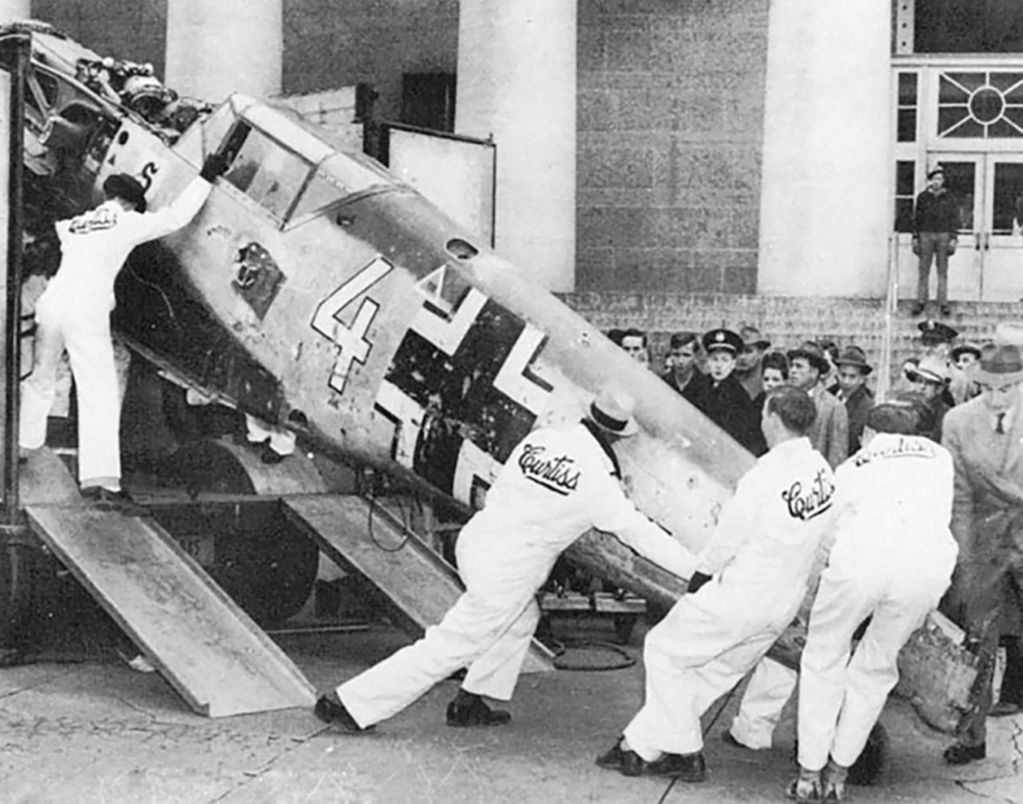
After the war, White 4 was taken to the Canadian Air Research Centre in Amprior, Ontario where it was held in storage. In 1961 it was examined by the Canadian War Museum who decided that it was beyond repair. The aircraft was purchased by two British aviation enthusiasts and returned to England where it was restored and on 17th March 1998 unveiled at the Imperial War Museum at Duxford which is where I saw it.

As I looked at the aircraft now safely on display, I wondered if maybe my mother or father saw it as it flew low over the Sussex coast? Who knows ?!
Sources:
Royal Air Force Flying Review, September 1959 (Authors Collection)
National Archives Kew (AIR40/2400)
University of Calgary (Digital Collection)
The painting of Horst Perez being captured (Hande Hoch) is by transport Graham Turner and copies can be obtained at www.studio88.co.uk
The painting of ‘White 4’ over Beachy Head is by aviation artist Geoff Nutkins and copies can be obtained at. www.aviartnutkins.com
Today you can even buy a model of White 4 to build at home!

 Quirky Sussex History by Kevin Gordon