Frederick (Fred) James Gordon was my great-uncle. He was born at 1am on 11th February 1894 and was delivered by Doctor Muir Smith at 23, Commercial Road, Eastbourne. His parents (my great-grand parents) were Frederick and Hannah Gordon.
Frederick had a long and adventurous life and my cousin Leeanna and myself hold photographs and postcards that he sent home to Eastbourne during his military career. I thought it would be an interesting project to record these.
Fred was baptised at St Anne’s Church in Upperton Gardens on 6th May 1894. The family moved to Chandlers Ford in Hampshire for a few years and it was here that Frederick ‘signed the pledge’ not to partake of alcohol. He was only 12 years old!

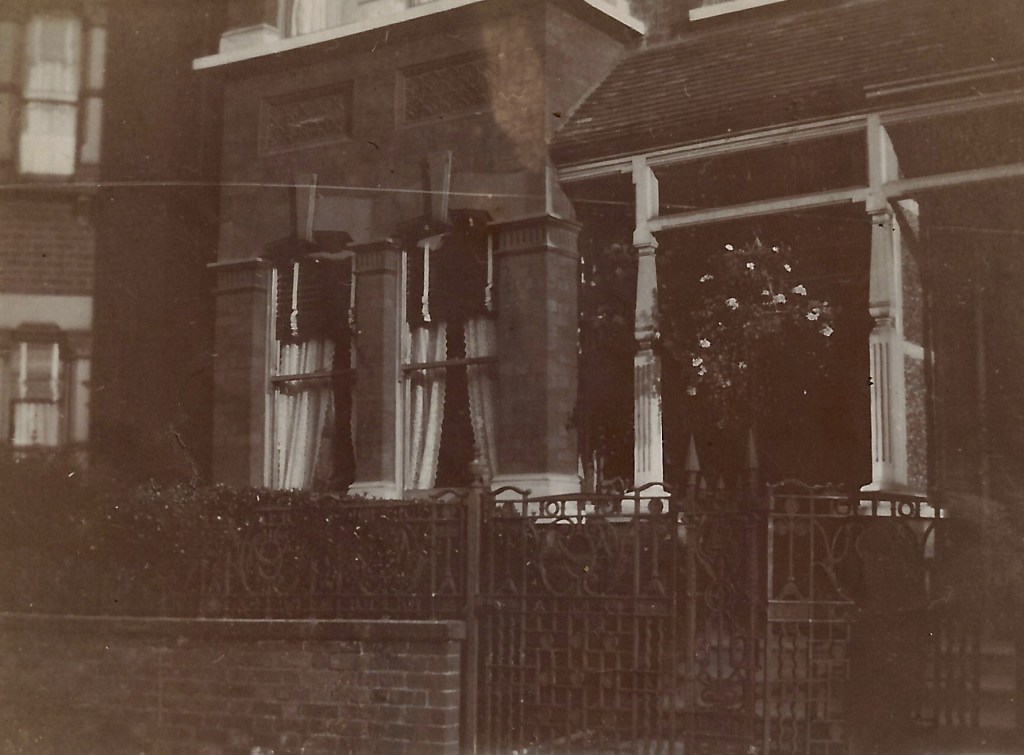
The 1911 census shows that the Gordon family had returned to Eastbourne and were now living at 1, Romney Street. At this time Fred was working as a draper’s assistant. A few months later the Gordon Family moved to 84, Channel View Road. It was to this address that Fred sent his letters and postcards home.
With the Great War well underway, Fred went Brighton where on 3rd March 1916, he joined the Royal Marines. He gave his occupation as a fishmonger. His service certificate shows that he was 5ft 6ins tall, had brown eyes and dark brown hair.
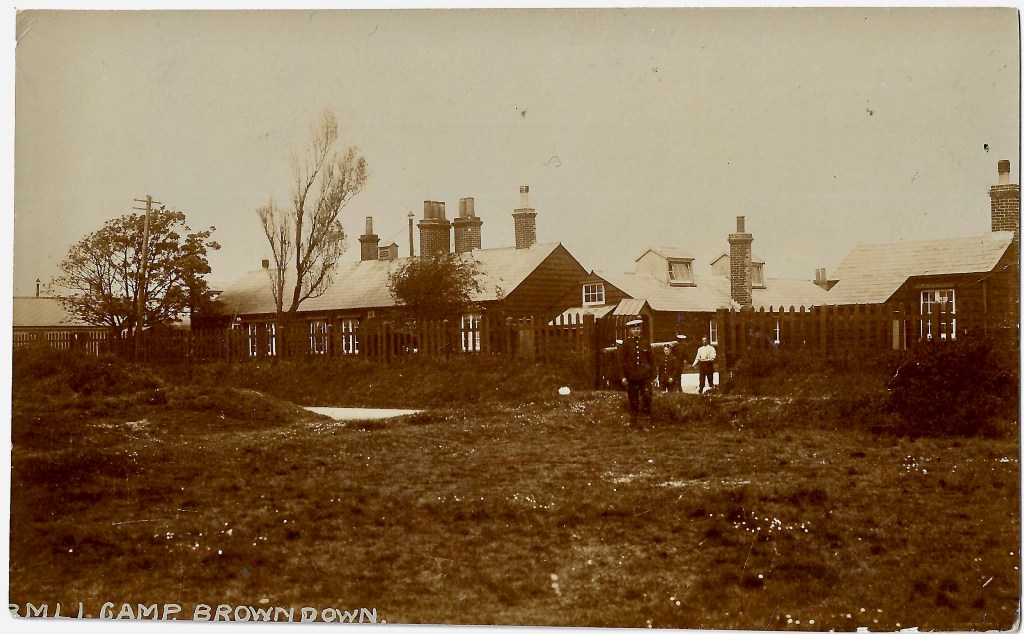
He was posted as Private 19255 to ‘C’ Company of the 3rd Battalion of the Royal Marines Light Infantry (RMLI) and sent to Deal in Kent for training. By the end of 1916 he was at Browndown Camp in Hampshire as a part of the Portsmouth Division.
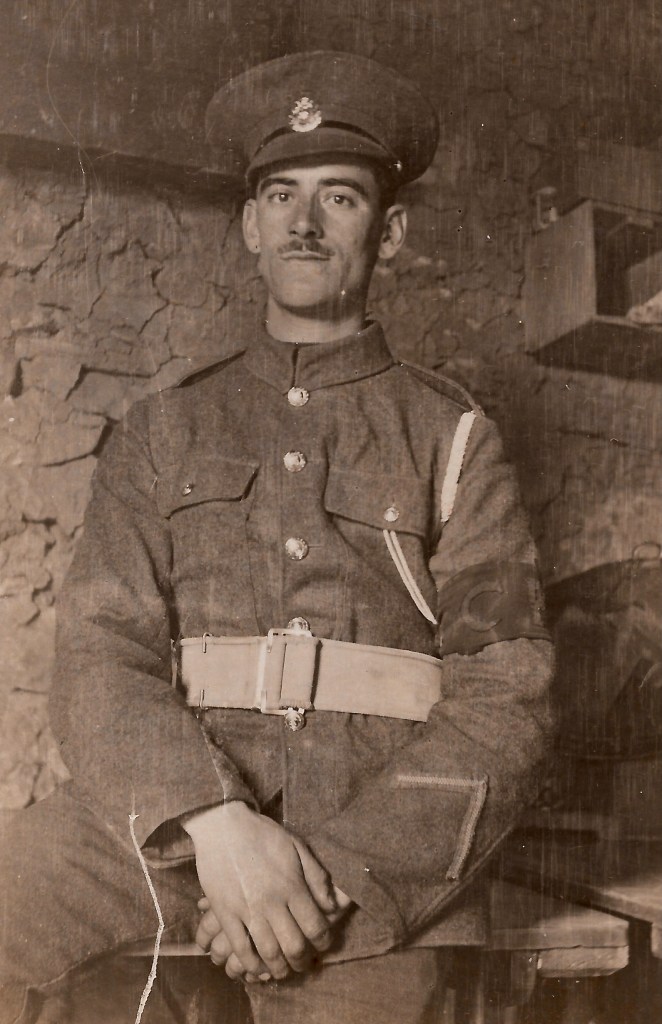
It appears that Fred’s first posting was to Mudros Camp on the Greek island of Limnos in the Aegean Sea. He was certainly there at Christmas 1916. Fred was on the island for at least a year before returning to Portsmouth for further training. He sent a postcard/photo of himself home dated 3rd May 1918. He has a moustache and is sitting on a wooden bench inside of a stone hut.
Fred spent Christmas 1918 off Turkey on board the battleship HMS Superb. Fred would have taken part in the “Armistice of Mudros’ which ended wartime hostilities in the Middle East. After this, the British occupied Constantinople (Istanbul) and Fred sent a postcard home showing his ship moored off the city.
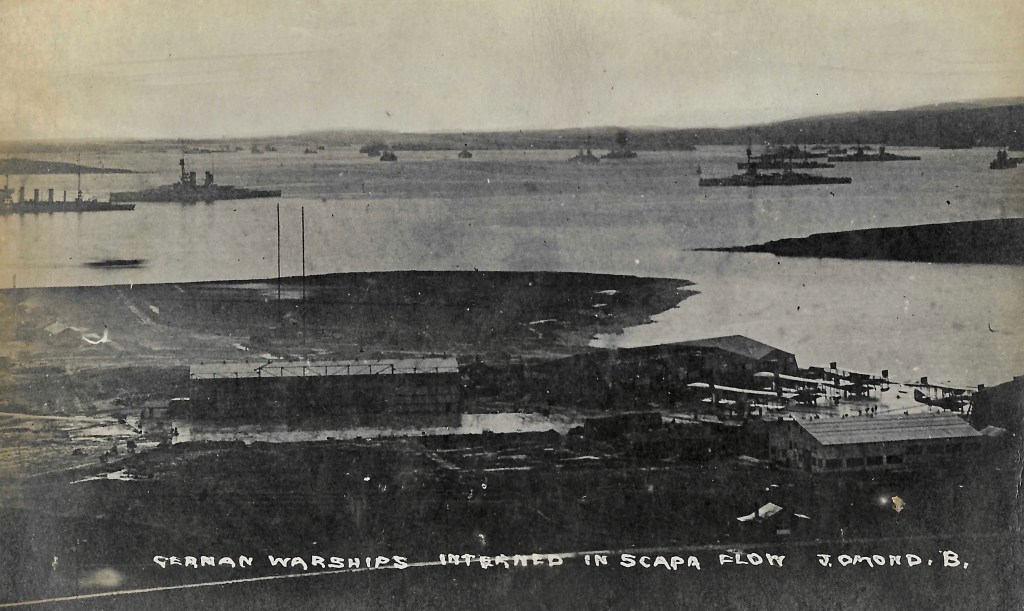
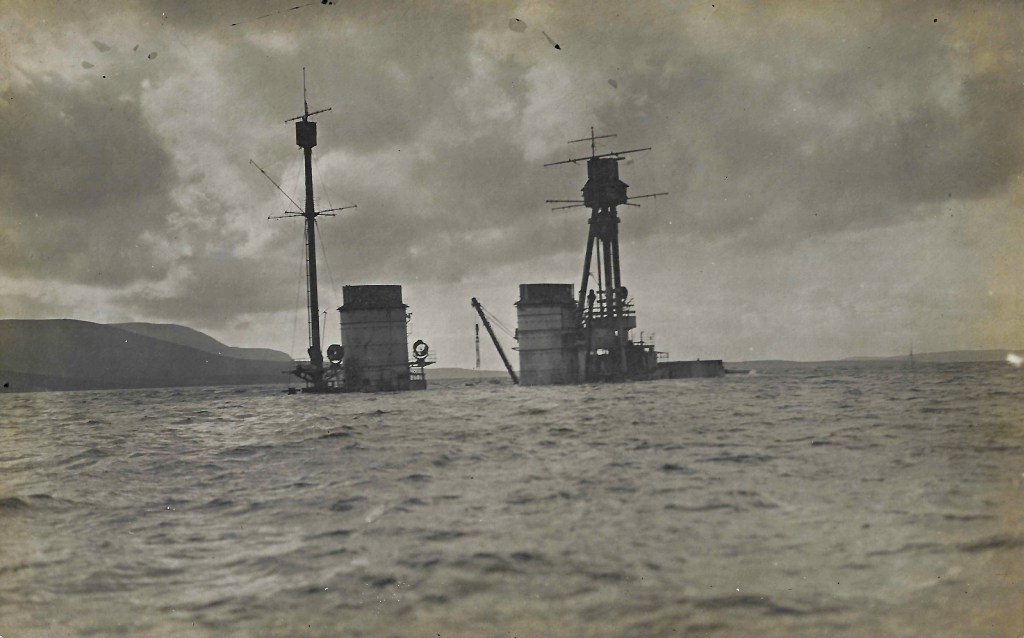
In 1920, Fred seems to have been in Scapa Floe in Scotland as two postcards of impounded German ships, were sent home to Eastbourne. One postcard shows the huge German battlecruiser Hindenburg which was scuttled in Scapa Floe on 21st June 1919.
On 20th March 1920 Fred was posted to the dreadnought battleship, HMS Temeraire which at that time was a part of the Mediterranean Fleet. A photo dated 12th September 1920 shows Fred and a large group of men with blackened faces having clearing been shovelling coal. One forgets that at this time the ship would have been coal-powered and would have needed thousands of tons of coal each month.

HMS Temeraire was decommissioned in 1921, so Fred was transferred to HMS Thunderer, an Orion Class battleship. The 1921 census was taken on 19th June and Fred’s address is shown as ‘HMS Thunderer, Portland Harbour, Dorset’.

From 15th November 1923 to 19th April 1926 Fred served on board HMS Birmingham. This saw him posted to Simonstown in South Africa. At Christmas 1924 he sent home a photo of himself on the hills above Simonstown reading a copy of the Eastbourne Mirror – he clearly missed home.

Later in 1926 Fred returned to England where he passed an Anti-Gas Course at Chatham in July and qualified as a Horse Transport Driver at Woolwich in April 1927. Re-engaged with the Royal Marines in November 1927. In 1928 and most of 1929, Fred served as Groom to Colonel George Carpenter OBE DSO.

The battleship HMS Ramillies was named after the Battle of Ramillies when John Churchill the Duke of Marlborough beat a French army on 23rd May 1706. It was launched in May 1917 and recommissioned as a part of the First Battle Squadron of the Mediterranean Fleet on 11th September 1929. The ship had a crew of 900 men which included 129 Marines. One of these marines was Private Fred Gordon of Eastbourne who was posted onto the ship the day before it sailed for the Mediterranean on 26th September.

After a brief stop in Gibraltar, HMS Ramillies arrived at Malta on 4th October where a month was spent on gunnery and torpedo practice.
On 24th October 1929 news was received of unrest in Palestine. This followed the ‘Balfour Declaration’ of 1917 which decreed that a ‘national home for Jewish people would be established in Palestine’. HMS Ramillies sailed east at full speed to Jaffa where it was hoped that the presence of the ship would be ‘sufficient to prevent any folly’.

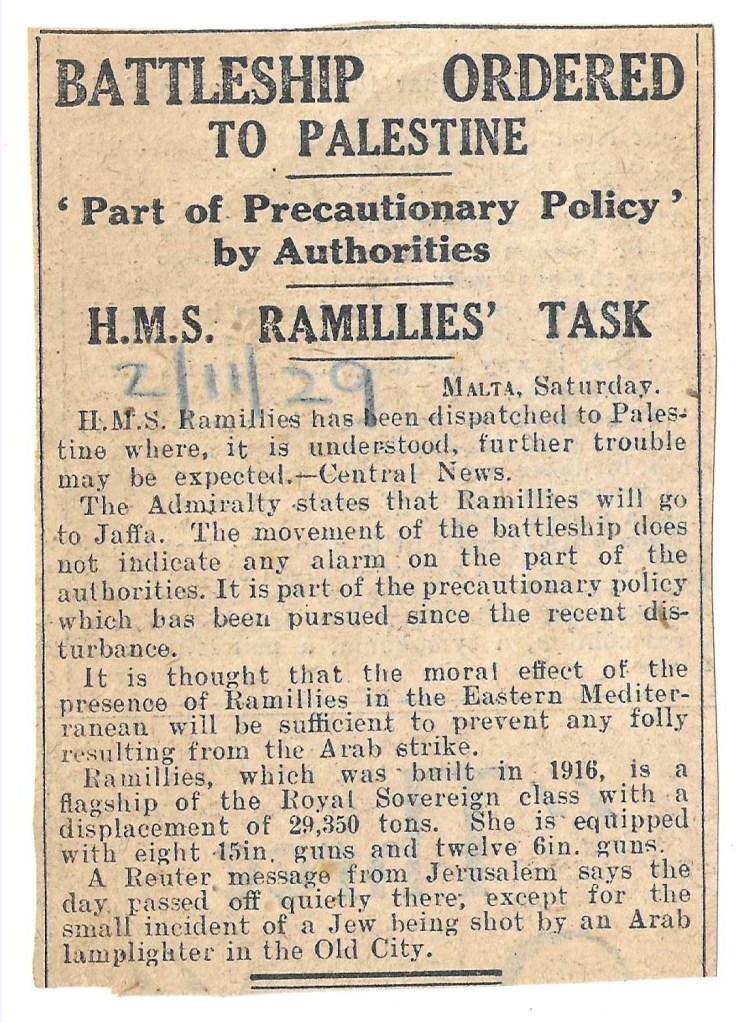
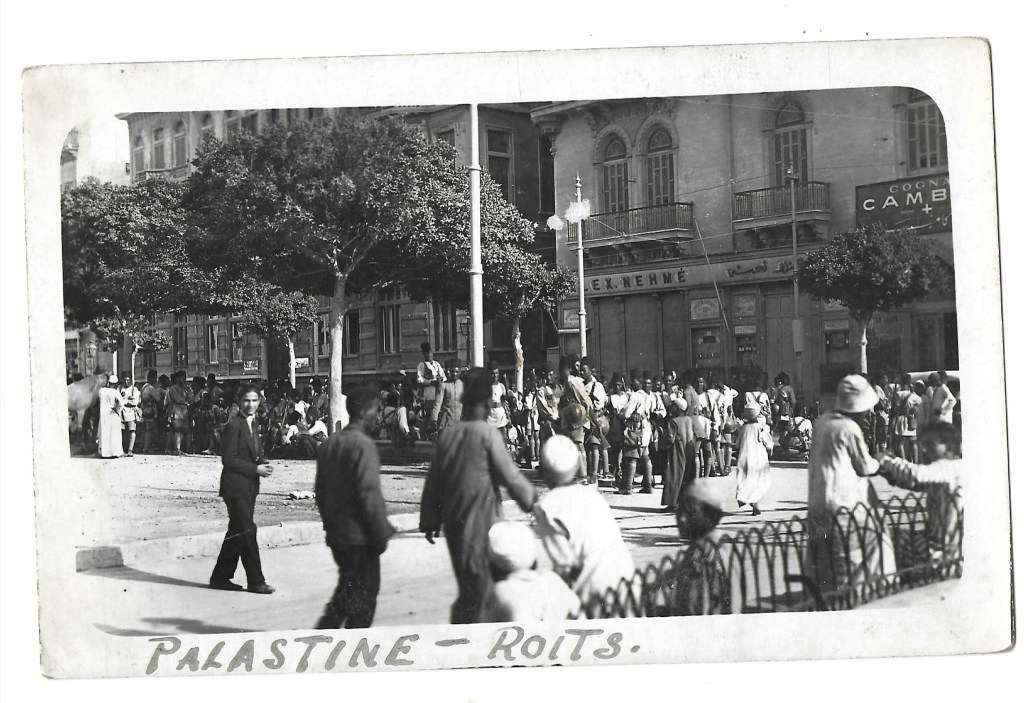
Fred practiced forming ‘landing parties’ parties en-route and on arriving at the coast sailed between Jaffa and Haifa, however by this time tensions were eased and Fred did not step ashore.
The next port of call for HMS Ramillies was Port Said in Egypt where the two weeks was spent. During the short voyage the radio operator picked up a message from a British cargo ship, the ‘Baron Elcho’. The message was “HEAVY CONTRABAND TRAFFIC ON THIS SHIP – COCAINE. REPEATED EFFORTS MADE TO DRUG AND MURDER RADIO – OPERATOR. URGENT – REQUIRE IMMEDIATE HELP”. The message was passed on to the Mediterranean fleet and four nearby destroyers HMS Witch, HMS Wren, HMS Whitehall and HMS Worcester intercepted the Glasgow registered ship taking a cargo of sugar from Egypt to France. Following a four-hour search of the ship nothing was found. HMS Ramillies sailed through stormy seas back to Malta for the winter.

Fred mentions that between 14th and 15th January 1930 he took part in ‘Fleet Exercises’ off Egmont, Malta.

This was halted when HMS Ramillies went aground at Fort Saint Angelo when entering the Grand Harbour. She was stranded for four hours before being refloated with the aid of six tugs. It is interesting that this incident is not mentioned in the official account of the ship or by the admiralty but was reported in the press.

On 8th March 1930 the Ramillies set sail for Gibraltar for the beginning of its ‘Spring Cruise’. Fred and his ship visited Algiers, Genoa in Italy and St Raphael in France.
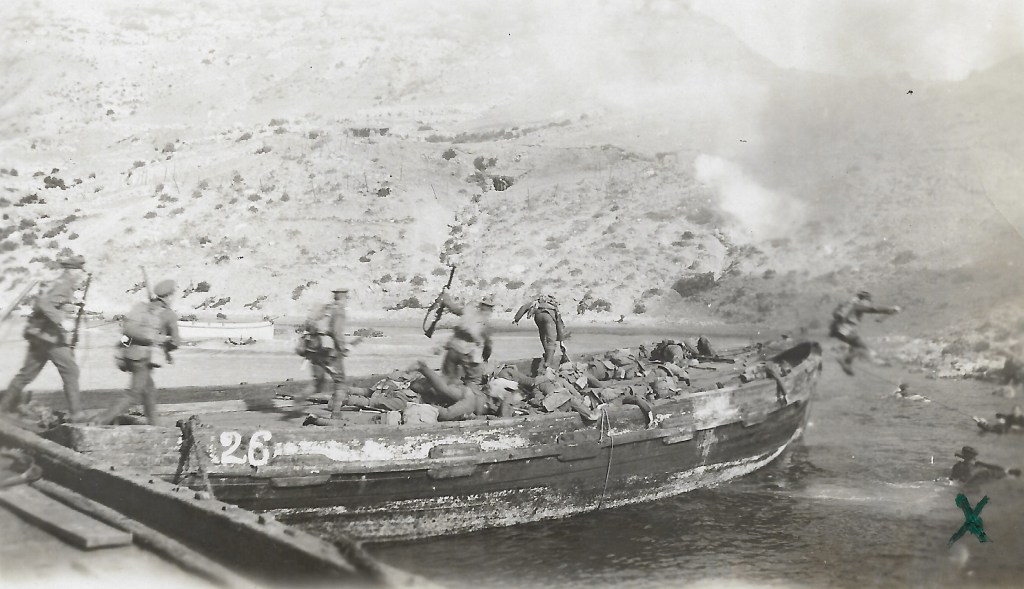
In April and May, Fred and other Marines were camped on Malta for gunnery practice and in June they took part in an unusual duty – they were dressed as Australian soldiers and recreated the Gallipoli landings of the Great War.

The family have a number of postcards and photographs showing the filming at Ghajn Tuffieha a secluded bay the west coast of Malta. Today the bay is a popular tourist destination but in 1930 it echoed with the noise from a past war. In the pictures Fred points out the exploding bombs, the bodies on the beach and himself, marked by a cross.
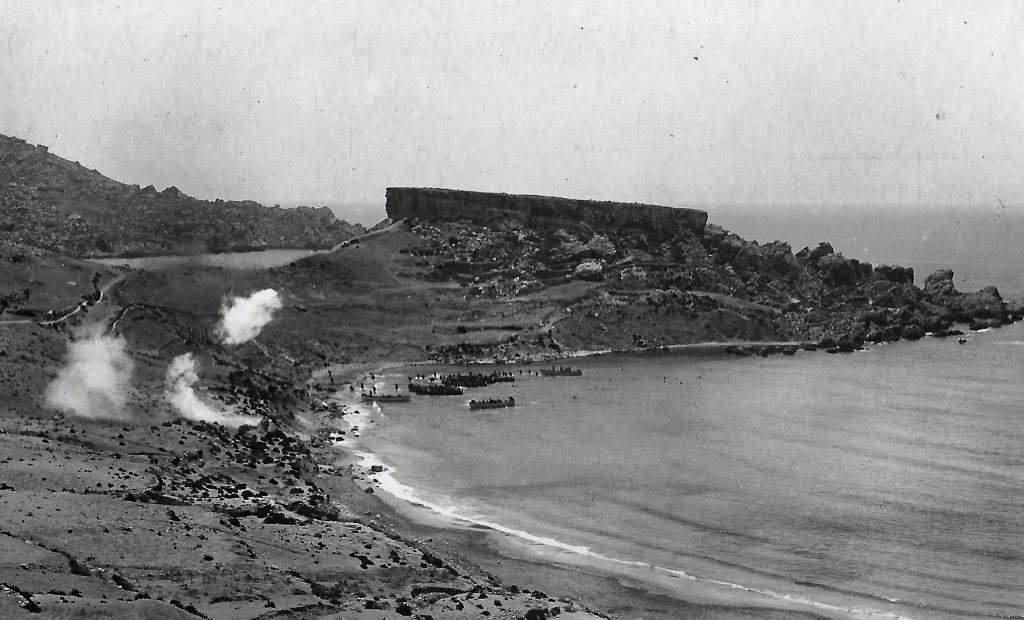
Once again the situation in the Middle East deteriorated and in July 1930, HMS Ramillies again was moored off Port Said in Egypt. It was here the ship entertained a celebrity for the day. The young aviator Amy Johnson was enroute home having become the first woman to fly solo from England to Australia. She was shown around the ship and warmly cheered by Fred and the rest of the crew.
HMS Ramillies returned to the Middle East later in 1930 and Fred had the opportunity to visit the holy towns of Damascus, Jerusalem and Nazareth. The ship then visited Larnica in Cyprus and the island of Corfu.
During 1931 HMS Ramillies continued to be a part of the First Battle Squadron of the Mediterranean Fleet. Although based at Malta, the Ramillies patrolled the eastern Mediterranean – I love the way the sailors described the operation as a ‘Spring Cruise’ !

Before they set off on their ‘cruise’ there was an incident. On Saturday 21st February, the liner ‘Empress of France’ was leaving Malta for Venice when it was caught by the wind when a strong wind blew her astern and nearly collided with HMS Ramillies. Fred took photographs calling it a ‘close shave’.

Just a few weeks later there was an actual collision when HMS Glorious crashed into the side of a French liner the SS Florida in heavy fog. 33 Italian emigrants on the liner were killed as was one sailor on the Royal Navy aircraft carrier. Fred witnessed both ships arriving in Gibraltar and took photographs.
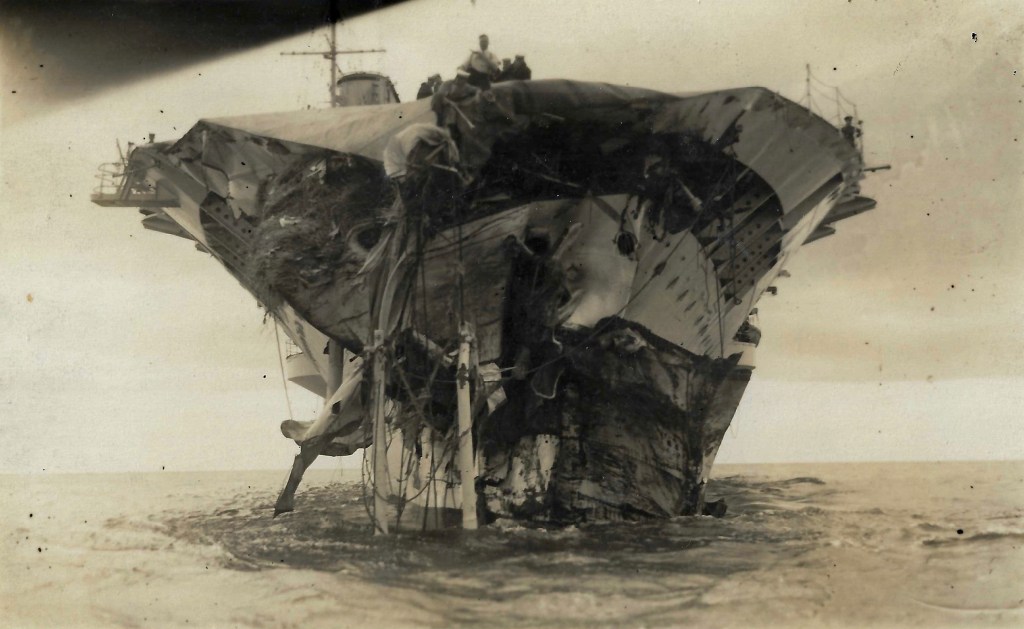
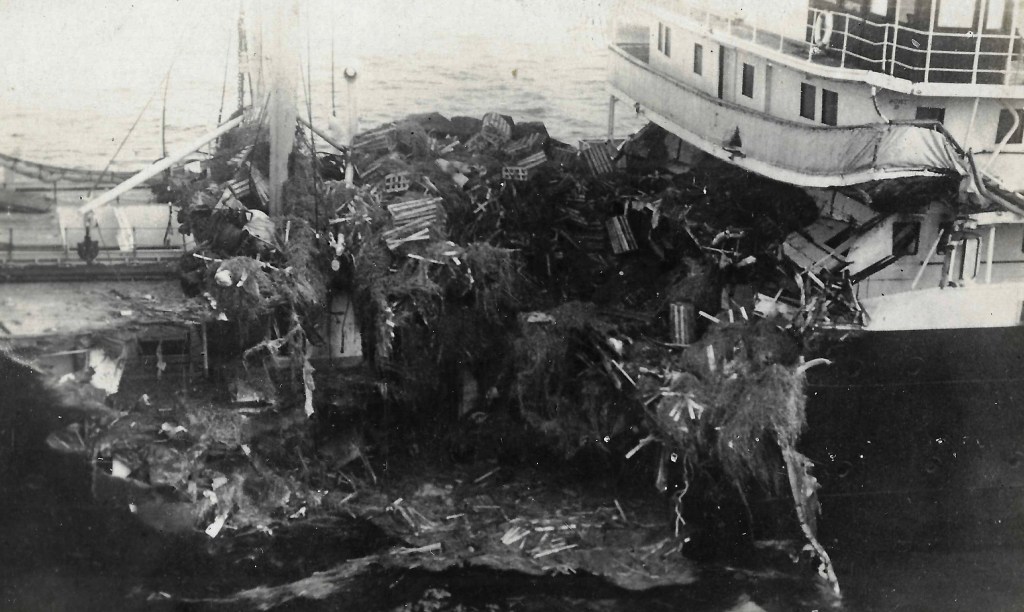
At this time one of the officers was Petty Officer Bartlam of St Annes Road, Eastbourne, he was later to describe the crew of HMS Ramillies as looking like a ‘crowd of pirates’!
Later in the year HMS Ramillies was involved with exercises with the Army and visited Korcula in what Fred calls ‘Hugo-Slavia’ (now Croatia).
In March 1932, it was decided that the size of the Mediterranean fleet would be cut for economic purposes and as a result HMS Ramillies was withdrawn from service. Fred returned back to Chatham in July
From May 1934 to June 1936 Fred served on board HMS Renown, taking part in its ‘Spring Cruise’ in 1935.

Fred was pensioned from the Royal Marines in March 1937 but he did not spend much time on ‘Civvie Street’ thanks to the expansion of the Third Reich. He rejoined the Marines at Chatham at the outbreak of the war, but now in his mid-forties, he remained at the Royal Marines Reserve Depot and did not see further active service. It is probable that he was allowed to live at home as he is shown in the 1939 register as living at 10, Canterbury Street, Gillingham, Kent with his wife Ellen.
Fred’s father died in 1936 and his mother the following year. Fred died in 1976 and I am sorry that I never met him.
Sources: Family Archives and National Newspaper Archives
 Quirky Sussex History by Kevin Gordon