John William Hills was born at the Police House in Glynde, East Sussex on 5th February 1891. His father (also John) was the village policeman. In 1912, John moved to East Dean when his father was transferred there and they lived in the Police House facing the village green near Dennetts Stores.

During the Great War, John served as a Gunner in the Royal Field Artillery. On 23rd August 1918, his 18-year-old brother, Claude was killed in action whilst serving in the East Surrey Regiment. John later dated a local girl, Winifred Hewitt.
John and Winifred married at East Dean Church on 4th November 1915 and afterwards moved into the Bake House which they shared with my great-grandparents Thomas and Emily Dickens. (Thomas was the village baker)

Later in the 1920s. John and Winifred moved to Seaford and by 1953 they were living at 9, West Dean Rise and this is where he was interviewed In June 1969. I don’t know who interviewed John, but I am lucky to have a copy of what he said:
My name is John Hills and I am 79 years old. I was born in Glynde but later we moved to Ringmer, Dane Hill and Hadlow Down. I went to schools at Dane Hill, Hadlow Down and Buxted. I would walk to school but sometimes got a lift in a dung wagon.
When we moved to East Dean it seemed very small, there were eleven houses, a church, school, a shop and the public house – the Tiger.

I remember that on Good Friday, a marbles ring was made on the green. A number of marbles were put in the ring and we took turns. We shied the marbles and tried to toss them into a hole in the middle. What went in you had – it was man’s game – women didn’t play. Over at Alfriston on May Day they danced on the burial mounds and sang ‘Here We Go Round the Mulberry Bush.’
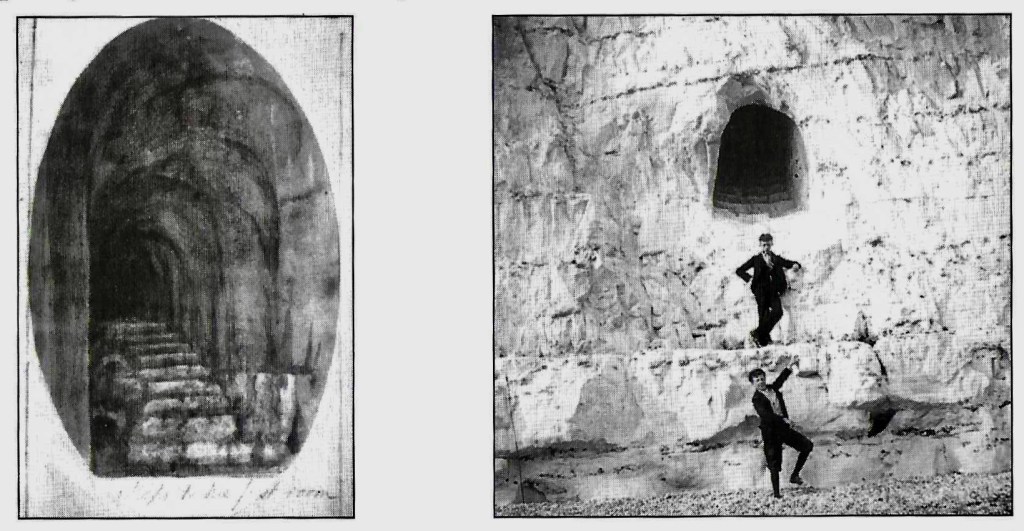
We would play at Birling Gap. There were two caves there then called Trinity Hole and Darby’s Hole. We would lower ourselves down into them with rope. Darby’s Hole had a smugglers cave cut into the chalk, you crawled in and there were four rooms. The last time I went in we were wearing celluloid collars but mine caught alight and I was burnt around the neck. You can still just see Trinity Hole but Darby’s hole is completely gone.
[Note: Darby’s Hole was named after Parson Jonathan Darby who became vicar of East Dean in 1706. He enlarged existing fissures to create a cave in the cliff, which was a refuge for shipwrecked sailors and during stormy nights also held a light to warn off ships. It is also said that he would use the caves as a refuge from his overbearing wife Anne!] [I am not sure what a celluloid collar was!]
My friends and I would come over to Seaford – mainly to meet girls. We would either walk or cycle over. I remember one night, when I was cycling home, my brakes failed as I was going down Exceat Hill and I ended up in the river!
There wasn’t much in Seaford then, just a square from Woolgar’s around the Post Office. There was a cinema in Sutton Road but it later burnt down. There was also a café at the Martello Tower where you could get a drink. In those days no tourists or foreigners would visit Seaford, only Londoners who would come down for the sea trips.
When I was old enough, I got a job working for Dennett’s who had the shop opposite the Tiger Inn on the village green at East Dean. We had a wagon drawn by horses, of course everyone moved around by horse in those days. I was a roundsman and three times a week I would go to Eastbourne to collect goods. One day I was at the station collecting goods for the shop when a girl asked me where Summerdown Road was. I offered to take her there and we later dated and got married.
I would also do the bread round – one day I would do Alfriston, Jevington, New Barn and West Dean and the next day Litlington, Friston, Crowlink, Birling Gap, Beachy Head and Halfway House.
[Note: I am rather thrilled to think that the bread that John was delivering was baked by my Great Grandfather Thomas Dickens]
I remember the oxen working at Friston – Bill Holter used to drive them, he is still alive and lives at New Barn. The oxen were used in two pairs for ploughing and harrowing.

When I was at East Dean I worked for a short time as a flint-miner. In one mine I found some skeletons which I have been told were Romano-British. I found several flint arrow-heads and a spear-head. I also found a Queen Mary silver groat when digging in the village.
When Winifred and me first moved to Seaford, I had a job working as a gardener at Friston. Our house was in Chyngton Lane, there were no locks only iron bars across the door. The rent was 18/6d. At Chyngton there was a big old fashioned bakers oven and at Sutton Corner there was a bullock yard where pigs were kept and also a riding stables which belonged to Miss Pitt.
I next got a job working in Alces Place, Firle Road as a gardener at £2 per week.
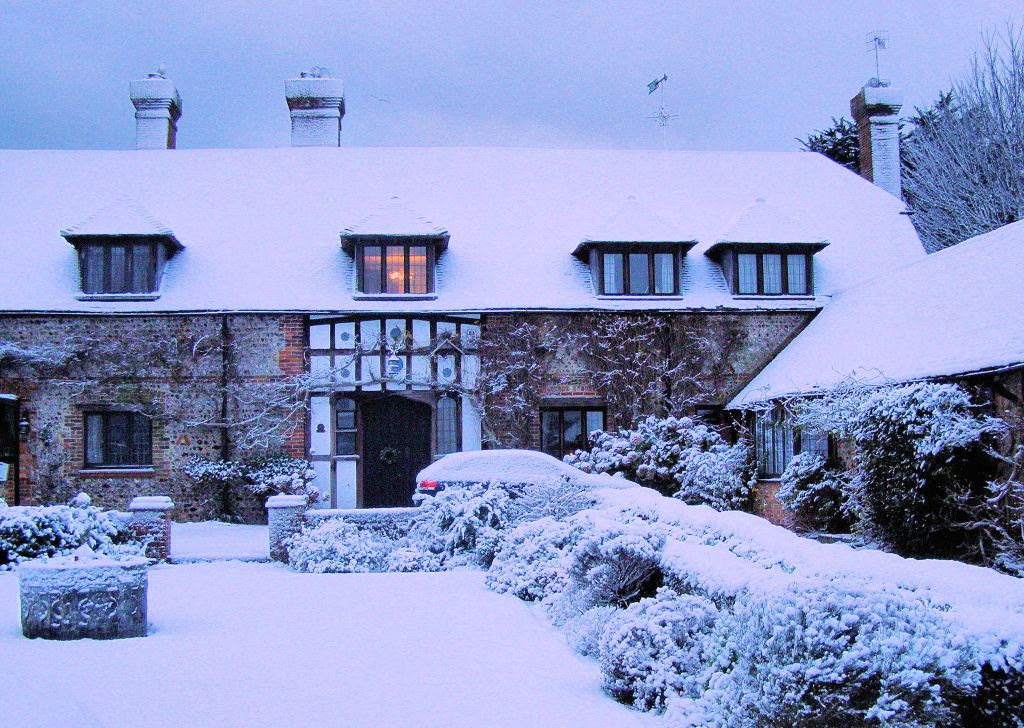
When the war broke out they wanted to halve my wages and in return allow me to take produce from the garden. I couldn’t do that so I went to work on the Potato Boats and then worked for Morlings for three years. After that I worked for the Garrison Engineer and helped to lay the water supply from Paul’s Farm to the Cuckmere Cottages. I then worked for Wilson’s at Alfriston and erected static water tanks.
The main shop in Seaford then was the International Stores in Clinton Place. There was little to do in the town apart from watching a football match or cricket at the Crouch. I spent much of my spare time gardening. Once, when I was digging in the back garden of our house in Vale Road, I found a gold gent’s signet ring which must have been dropped by one of the soldiers from the North Camp during the First World War. I sold it for five shillings. I never found anything else interesting apart from dead bodies washed up on the beach.
I remember the Salts before it was laid out. In the winter, it was just a pond surrounded by flint walls, it was a bit of a dump really, people used to hang their washing out there, although the people from the Coastguard Cottages used to lay their washing on the beach to dry.

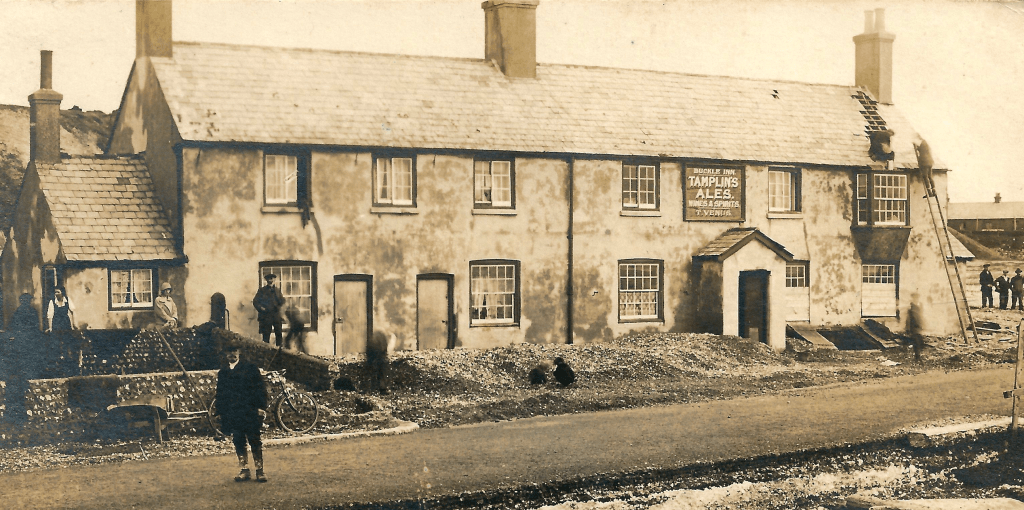
There is a sharp corner further along at the Buckle; one night a man was coming to work on a motor bike and he took that corner too fast. He went right over the sea wall and neither he, nor his bike, were ever seen again. There was a lot more beach on the foreshore then and it came up to about twelve inches from the top of the wall. It has all disappeared now since the groining.
When we lived at East Dean I used to go to Birling Gap to fish. I learned how to make fishing nets from my old uncle whose name was ‘Bones Hyde’.
[Note: This was Charles ‘Bones’ Hide 1849-1905 who lived in Eastbourne where he was a fisherman and the Coxwain of the Lifeboat]

I later fished at Seaford. Fishing was really fishing those days – you would come home with a bag full every time. Sometimes we would use a 50lb butter-basket to catch prawns.
The brooders came in on Good Friday and we could catch two or three hundred from the beach and take them to Eastbourne to sell an 2/- per hundred.
[Note: I believe ‘brooders’ were mackerel]
One night I was fishing off the Buckle beach at Seaford with some friends using a sixpenny handline. I threw out the line and caught an 11 foot conger eel – it was longer than this room! It took three of us to pull it ashore. We didn’t know what it was as all you could see was these two green spots which were its eyes. It was the biggest eel I have ever seen. Mr Venus from the Buckle Inn public house came down onto the beach when he heard us shouting and hit the eel over the head – we thought it was done for but when I touched it, it suddenly barked – it wasn’t dead at all.
I put it over my shoulder and it was so long, the head and tail dragged on the ground. I was slimed right up by the time I got it home. The next day, I tried to skin it but I couldn’t. I didn’t know what to do with it so in the end I chopped it up and buried it in the garden and guess what? I had the best crop of potatoes you have ever seen – and tomatoes too – I have never seen such a good crop!
John died in Eastbourne in 1983. I wished I had met him – I would have had lots of questions for him about his life. I would love to know more about the legendary Parson Darby’s Hole, those ancient skeletons and life in Seaford – but particularly what it was like living in the East Dean Bake House with my Great Grandparents!
Sources:
Seaford Museum & Heritage Society
Jim Marsh Collection
East Dean & Friston by John & Sheila Surtees
The Fishermen of Eastbourne by Ted Hide
 Quirky Sussex History by Kevin Gordon