An old police friend, ex Inspector Bill Tee of the BTP from Crewe, has sent me a photo of his great-great uncle, former Sussex policeman George Berry. As I enjoy my local history, I said I would try to find out more.
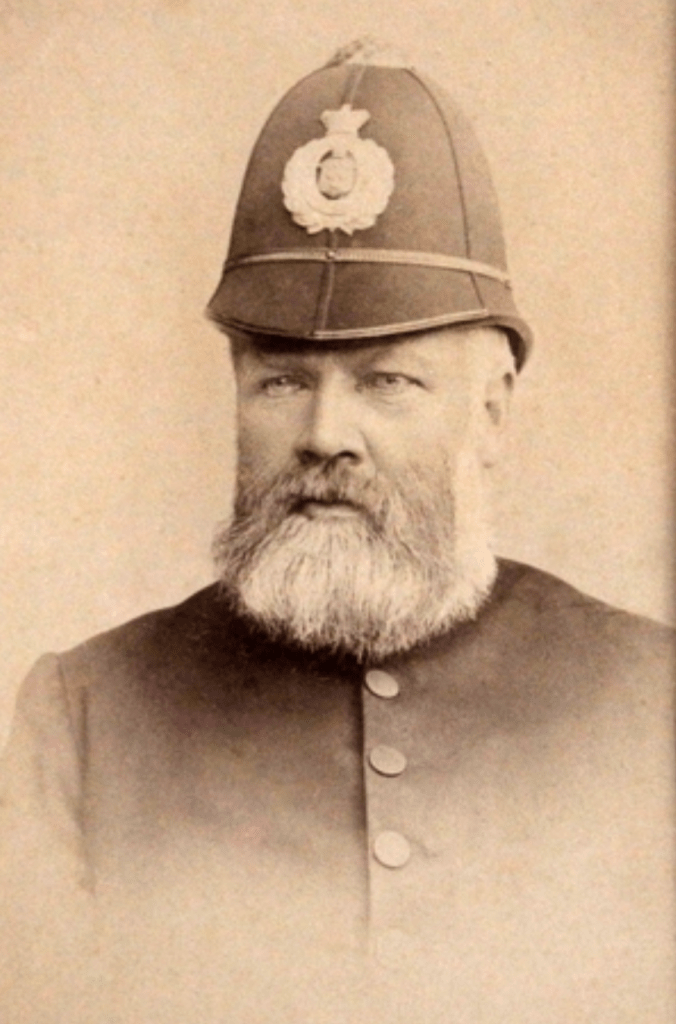
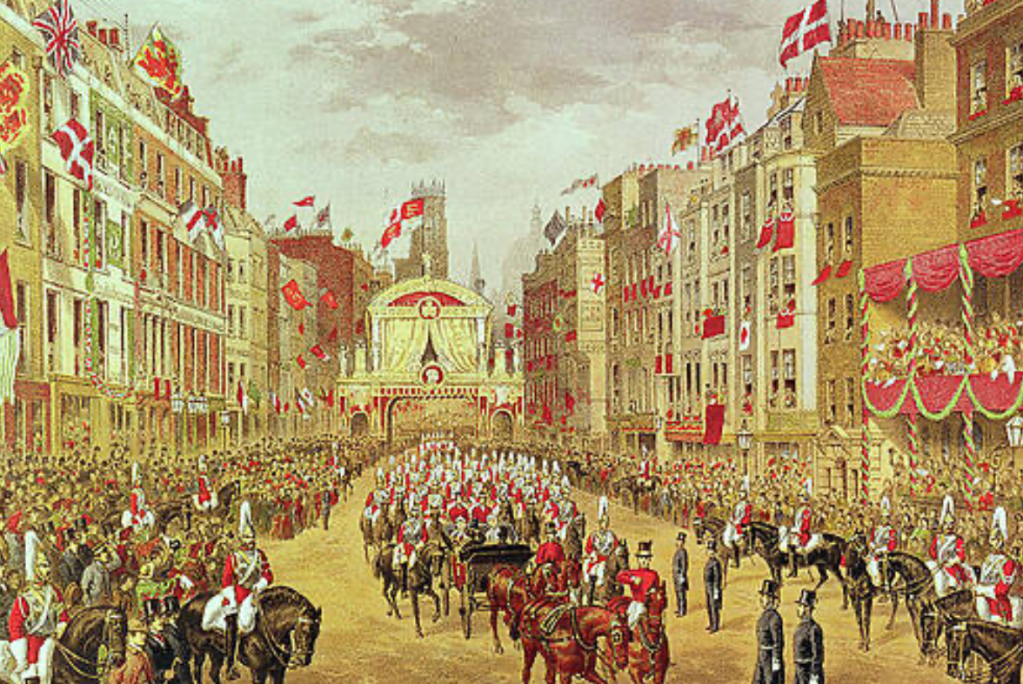
George was born at Woolbeeding, West Sussex on 17th January 1840. His parents were shoemaker, Thomas Berry and his wife Emily (nee Older). Neither of his parents could read or write but George did well for himself. On leaving school, he worked as a milkman for a few years but on 17th September 1860 he joined the Metropolitan Police and was posted to Marylebone Police Station in London. He later transferred to ‘A Division’ (Whitehall) and was on-duty when Prince of Wales married Princess Alexandra of Denmark (later King George V and Queen Alexandra) on 10thMarch 1863.
In December that year, George, obviously missing his home county, applied for and was accepted to transfer into the Brighton Police.
George made a good name for himself in Brighton and conducted numerous arrests, many for drunkenness. I particular liked a report of his arrest of Henry Carter for being drunk in Edward Street. In court, the prisoner was asked if he was guilty. His reply was “Of course I am or I wouldn’t have been arrested!” I wish more criminals were as candid! Whilst in Brighton, George found a wife (or maybe she found him); he married Martha Bryant at the ancient St Nicholas Church in the town centre on 9th February 1864.

In 1866 PC Berry was poached by Colonel MacKay, the Chief Constable of the East Sussex Police. This transfer was apparently done to the great annoyance of the Brighton Chief Constable who knew he was losing a good man.
The first post for George was as the village constable for Lindfield, near Haywards Heath. Almost immediately he was investigating serious crime. In January 1867, the body of a newborn child was found in a well. George made enquiries and soon interviewed Emma Whall, the 19 year old daughter of a local hairdresser. He arrested her on suspicion of murder but she was subsequently found guilty of concealing a birth. It is interesting that such a serious crime was handled by the village constable.
George became a well-respected police officer, however in 1868 he had a difficult arrest. At that time there was a problem with poachers in the area. One dark, stormy night he questioned a man in possession of a number of stolen pheasants, a fight ensued and George was badly beaten and pushed into a ditch. When he came round, and despite being badly injured, he managed to track and trace the offender and arrest him. The prisoner, William Allin was not your average rustic petty-criminal – he was a school teacher! The residents of the area were so impressed with his work that they presented George with a silver watch and a purse of money. George however never fully recovered from his injures which bothered him throughout the remainder his service. He once made no less than three separate arrests in one evening in Lindfield and once caught a thief red-handed who was stealing items from Lindfield Church. He was also rewarded by the R.S.P.C.A. for his work in combatting animal cruelty.
The Sussex Express tells us that ‘he had many interesting cases, numerous and important’ so it was not surprising that in January 1872 he was promoted to sergeant and posted to Staplefield.
In 1879 George was promoted to Superintendent in charge of the East Grinstead division. On 11th November 1884 he received his final promotion to Deputy Chief Constable of the East Sussex force however, although the police HQ was in Lewes, he remained living in East Grinstead.
In 1890, George travelled up to Liverpool to give evidence for the case Arthur Edward Penfold, a 31 year old Sussex man from East Grinstead who had stabbed to death his lover in the back of a taxi-cab. Penfold, who had served in the militia in Eastbourne was clearly mentally ill and Superintendent Berry, as well as giving the court evidence of Penfold’s criminal past in Sussex, also told the court that the prisoner and several members of his family suffered from insanity. With the assistance of George’s evidence, Penfold was spared the gallows and sentenced to life-imprisonment.

Back home, in February 1894 George was enrolled into the local lodge of the Royal Antediluvian Order of Buffaloes. In May that year, the Chief Constable of the East Sussex Constabulary retired and George was effectively in charge of the force for a few weeks before the new chief took his post.
George loved his cricket and it was said that many of his ‘daisy cutters’ caught out a batsman. He managed to arrange an interesting match in August 1892, when he challenged the local cricket club (The East Grinstead Wanderers) to a game. He captained a team consisting of himself, this nine sons and one son-in-law. It was a ‘capital game with a close finish’ and George himself took four wickets. In June 1894 he challenged Superintendent Waghorn to a match. Both men selected their own ‘eleven’ formed by their favourite constables. The match, promoted as ‘Policeman’s Day’ was held at the Dripping Pan ground at Lewes with a break for lunch held at the Royal Oak in Station Street. Each side took an innings with George’s under-arm deliveries catching out many fellow constabulary batsmen.

He was the Deputy Chief Constable for ten years before retiring on 22nd October 1894 after 34 years police service, of which over 30 were spent in Sussex. To give an idea of how popular he was, on his retirement a ‘public testimonial’ was made and Viscount Cantelupe (later Earl De La Warr) presented him with a purse containing £210 – about £17,000 in todays money. East Sussex Magistrates presented him with a clock and the Sussex Express described him as a ‘cute officer with a kindly disposition’. The term ‘cute’ seems odd but at the time, the dictionary definition of the word was ‘clever, cunning and shrewd.’ (not that he looked like a kitten!)
George died at home in bed on 8th June 1898. His wife told the local paper that, although her husband was in poor health, he was intending to attend the Lingfield Races that day. On the day of the funeral, businesses on the route of the procession closed and private houses closed their blinds and curtains as a mark of respect. Eight uniformed constables (PCs Lancaster, Bateup, Marchant, Tappenden, Berry, Brown, Howell and Elphick) carried his coffin and hundreds of people followed the procession to the cemetery where the Reverend Blakiston conducted the service.
Two of his nine sons followed him into the police and were constables based at Hastings. Many years later, another descendant joined the British Transport Police and I hope that Bill now knows a little bit more about his talented ancestor.
Sources: National Newspaper Archives and “Sussex Police Forces (Poulsom, Rumble and Smith)1987
 Quirky Sussex History by Kevin Gordon
fascinating!
Peter White
LikeLike
What an interesting piece of research Kevin. Well done ! I thoroughly enjoyed this read. Cheers, Peter
>
LikeLike